 how-to
Professional Landscape Lighting Installation Services
Last Updated: November 1, 2026
Quick Summary
Professional landscape lighting installation services cover design, wiring, and mounting of exterior lighting built around your property, including fixture placement, low-voltage cable, transformers, and circuit testing. A good installer walks the property after dark before quoting, because shadows and sightlines change once the sun drops.
- A typical install runs five stages: night walkthrough, design plan, trenching and wiring, fixture mounting, then testing and adjustment.
- Mount path lights 12-18 inches above grade and space them roughly 6-8 feet apart so light pools overlap.
- Low-voltage systems run on 12 to 15 volts through a transformer and are the standard choice for residential landscape lighting.
- Voltage drop is the most common reason a system looks dim at the far end of a cable run.
- Ask for a line-item estimate separating fixtures, transformer, cable, labor, and restoration to compare bids fairly.
Table of Contents
- What Professional Landscape Lighting Installation Services Include
- The Landscape Lighting Installation Process, Step by Step
- Choosing Landscape Lighting Fixtures and Techniques
- Low-Voltage Landscape Lighting vs. Line-Voltage Systems
- What Landscape Lighting Installation Cost Depends On
- Request a Custom Quote from Go Coastal Electric
- Frequently Asked Questions
What Professional Landscape Lighting Installation Services Include
Professional landscape lighting installation services cover the design, wiring, and mounting of exterior lighting systems built around your property. Professional landscape lighting installation covers the full scope: planning fixture placement, running low-voltage cable, setting transformers, and testing every circuit before the work is complete.
A good installer walks the property after dark before quoting anything. You cannot place landscape lighting well from a daytime glance, because shadows, tree cover, and sightlines from the street all change once the sun drops.
Design and Planning for Your Outdoor Living Space
Design is where most projects succeed or fail. Good design planning maps the property, notes the landscape features worth highlighting, and decides which areas need visibility versus atmosphere. Patio lighting gets softer output; walkway edges get brighter, lower-glare fixtures. A solid plan also covers cable layout and transformer location so nothing gets buried in the wrong spot and dug up later.
Residential and Commercial Installation Scope
Residential installation typically covers paths, beds, decks, driveways, and home exteriors. Commercial installation adds parking lot edges, signage washes, entry canopies, and security lighting zones. Both scopes involve the same core work: fixture placement, wiring, transformer sizing, and electrical safety checks. If you want to confirm which electrical services are available for your property type, review our full range of electrical services before you call.
The Landscape Lighting Installation Process, Step by Step
A typical landscape lighting install runs in five stages: property walkthrough, design plan, trenching and cable layout, fixture mounting, then testing and adjustment.
A typical sequence looks like this:
- Night walkthrough. The property is viewed after dark to find glare problems and dark gaps.
- Design plan. Fixture types, beam angles, and transformer placement get locked in.
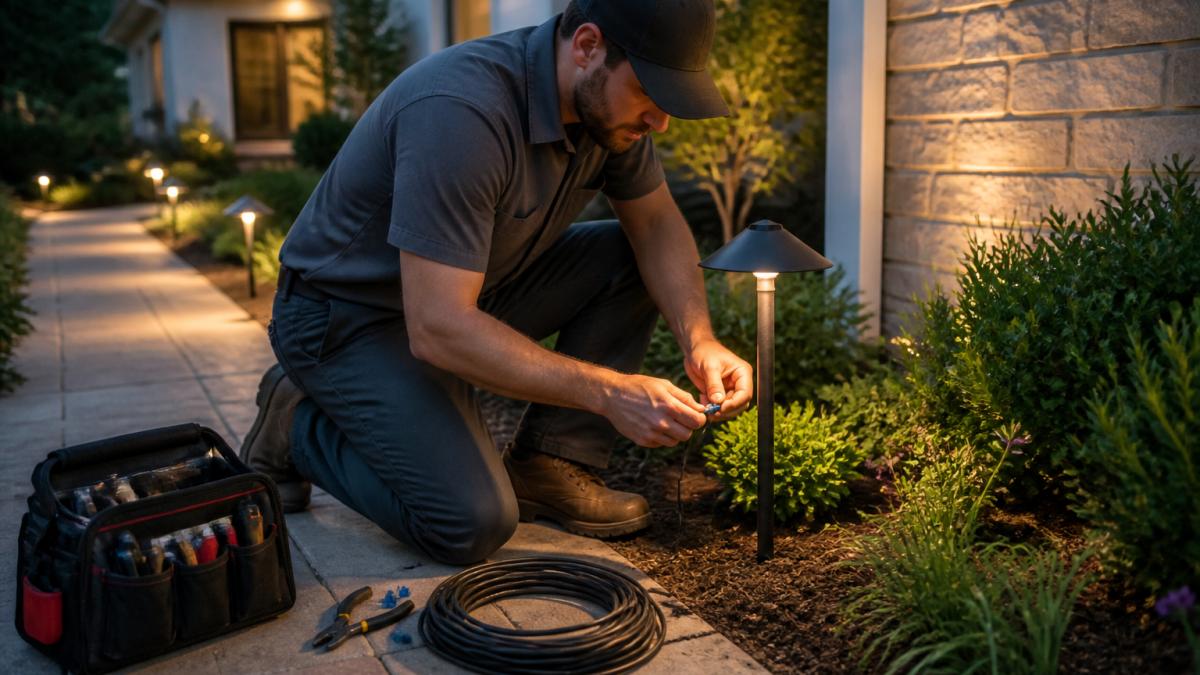
- Trenching and wiring. Cable goes in at the right depth, with slack left at each fixture point.
- Fixture mounting. Path lights, uplights, and accent lights get set and aimed.
- Testing and adjustment. Voltage is checked at the last fixture, then aim and timers are fine-tuned.
Wiring, Transformers, and Voltage Drop
Voltage drop is the loss of voltage along a cable run, and it is the most common reason a system looks dim at the far end. Long runs on undersized cable push the last fixtures below their operating range. A low-voltage transformer should be sized against total fixture wattage with headroom to spare, and runs can be split so no single cable carries too many lights.
Choosing Landscape Lighting Fixtures and Techniques
Fixture selection comes down to three decisions: what you are lighting, how far away the fixture sits, and how much glare you can tolerate. LED fixtures dominate now because they run cool, last for years, and draw a fraction of the power of older bulbs. Weather-resistant housings matter in coastal areas, where salt air and heavy rain punish cheap metal.
Path Lights, Uplighting, and Accent Lighting
Each technique does a different job, and the fixture type should follow the job:
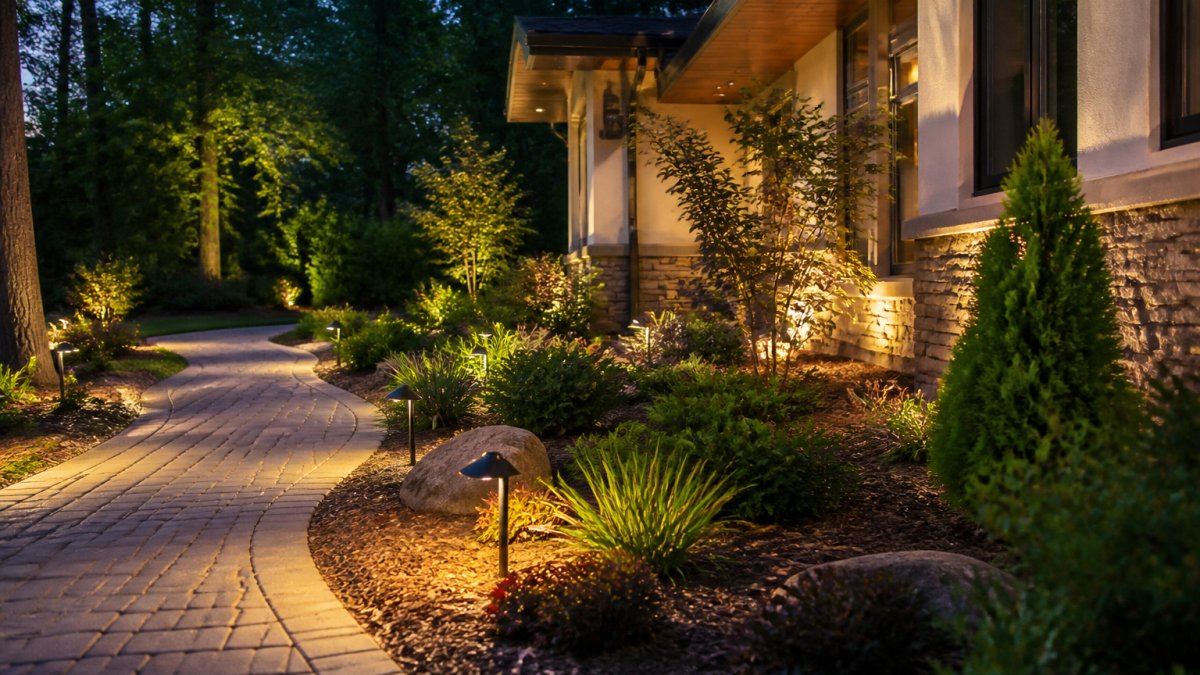
- Path lights mark walkways and steps with low, downward light. Mount them 12-18 inches above grade and space them roughly 6-8 feet apart so pools of light overlap slightly instead of leaving dark gaps.
- Uplights throw beams up walls, trees, and columns for drama. Place them close to the base of the feature and aim slightly off-axis so the beam grazes the surface rather than blasting straight up.
- Downlights mounted in trees or under eaves create soft pools of ambient light. A narrow beam from height gives a moonlight effect; a wide beam washes a patio.
- Wall washes spread light evenly across a facade. Keep the fixture a foot or two off the wall and use a wide beam to avoid hot spots.
Beam angle and glare control separate a professional job from a hardware-store kit. A wide beam on a short path light blinds people; a narrow beam aimed badly leaves hotspots on the siding. Common practice is to aim for a beam angle of 30-60 degrees for path lighting and 10-30 degrees for accent and uplighting, then shield or hood the fixture so the source itself stays out of sight.
LED choices and controls are part of the same decision. Warm-white LEDs (around 2700-3000K) suit most residential landscapes, while cooler temperatures read as commercial or security lighting. A photocell turns the system on at dusk, a timer sets an off time, and smart controls let you dim, schedule, and zone the system from a phone. Decide on the control option you want at design time, since adding controls later can add cost.
Low-Voltage Landscape Lighting vs. Line-Voltage Systems
Low-voltage lighting runs on 12 to 15 volts through a transformer and is the standard choice for residential landscape lighting. Line-voltage systems run at 120 volts and suit larger commercial installs or long runs where voltage drop becomes hard to manage.
| Feature | Low-Voltage | Line-Voltage |
|---|---|---|
| Typical voltage | 12-15V via transformer | 120V direct |
| Best for | Residential beds, paths, patios | Large commercial runs |
| Wiring depth | Shallow trench | Deeper, conduit often required |
| Safety | Lower shock risk | Requires licensed work |
| Fixture options | Broad | Narrower |
Either way, the work should be done by a licensed electrician who understands local electrical codes and permit requirements. Faulty exterior wiring is a safety issue, not a cosmetic one.
What Landscape Lighting Installation Cost Depends On
Landscape lighting installation cost depends on fixture count, fixture quality, cable run length, transformer size, and how much trenching the property needs. A small path-lighting package and a full-property design with uplighting sit at very different price points.
Most quotes bundle five line items. Asking a contractor to separate them is the fastest way to compare bids fairly:
- Fixtures. Fixture prices depend on material, quantity, and project scope, so ask for a line-item estimate. The housing material drives how the fixture handles sun, salt air, and water ingress.
- Transformer. Transformer pricing depends on wattage, brand, and features such as timers or photocells, so request a quote for current figures. Size the transformer against total fixture wattage with adequate headroom.
- Cable and connectors. Direct-burial low-voltage cable is usually priced per foot, and waterproof connectors add a small cost per fixture. Cheap connectors are a common failure point.
- Labor. Labor covers layout, trenching, mounting, aiming, and testing. Trenching through established beds, tree roots, or hardscape costs more than open lawn.
Total project cost depends on run length, fixture count, and site access, so pricing varies widely between a modest path-and-bed package and a full-property design. Request a quote for pricing specific to your property.
Projects are quoted individually because a flat per-fixture rate can hide the real variables. If you want to understand what drives the estimate before you commit, our lighting and electrical FAQs answer the questions homeowners ask most. For a firm number, request a professional project estimate and we will walk the property first.
Request a Custom Quote from Go Coastal Electric
The gap between a system that looks right and one that fights you every season comes down to planning. Homeowners who attempt DIY installs often end up correcting voltage drop, glare, or shallow cable burial, and those fixes can cost more than doing it right the first time.
Go Coastal Electric brings licensed electricians, a custom design plan for every property, and support for both residential and small commercial projects.
Request a custom quote to get started with a walkthrough, a design plan, and a clear estimate.
Frequently Asked Questions
How much does professional landscape lighting installation cost?
Landscape lighting installation cost depends on the number of fixtures, cable runs, transformer size, and site conditions, so there is no single figure that fits every yard. A small path-light setup costs far less than a full design with uplighting and accent lighting across a large property. Request a quote from Go Coastal Electric for pricing specific to your landscape.
Is low-voltage landscape lighting worth it?
Low-voltage landscape lighting is worth it for most homeowners because it uses less energy, is safer to install around planting beds, and works well with LED fixtures. It gives you path lights, uplighting, and accent lighting without the deeper trenching that line-voltage systems require. If you want security lighting and curb appeal with lower operating costs, low-voltage is usually the practical choice.
Can landscape lighting be installed without damaging the yard?
Yes. A clean installation keeps trenching shallow and routes cable layout around root zones, irrigation lines, and established plantings. Professional installers plan fixture placement first, then pull cable with minimal landscape disruption and backfill as they go. Expect some soil disturbance along the cable path, but a careful crew leaves your lawn and beds looking intact when the job is done.
How do I choose a landscape lighting installer?
Look for licensed electricians who provide a written project estimate, explain fixture selection and transformer sizing, and can show customer reviews from local projects. Ask whether they handle both residential installation and small commercial installation, and confirm they follow electrical safety codes for outdoor wiring. A local contractor who answers questions clearly and gives you a real scope in writing is a safer bet than the lowest bid.